EIA Projects Rising Electricity Prices, Widening the Gap with Natural Gas to 4.0x in 2027
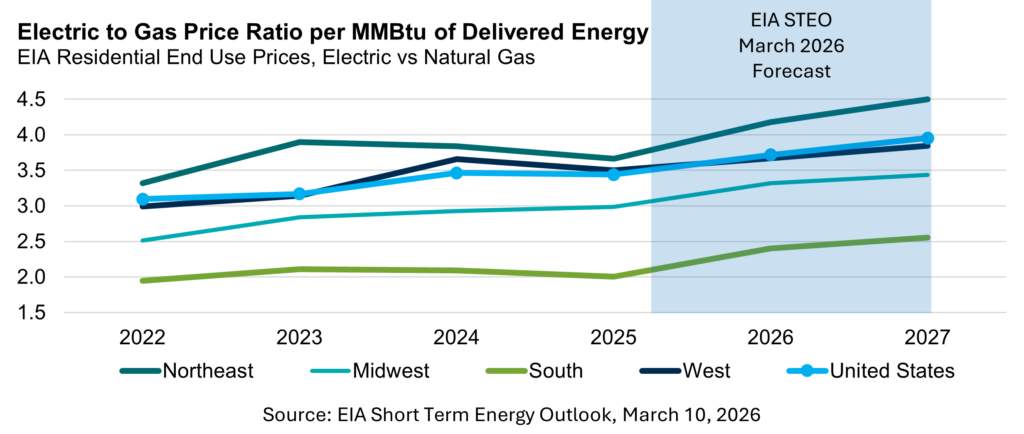
Comparing natural gas and electricity on a delivered-energy basis, by converting both to a common unit (MMBtu), highlights why direct-use natural gas remains important for households and businesses, especially for space heating and other on-site end uses. In 2024, the U.S. average residential price for natural gas was $14.00/MMBtu, compared with $48.30/MMBtu for electricity, electricity being 3.5 times higher. The Energy Information Administration (EIA) projects that the price gap will widen further, with electricity prices reaching 4.0x the price of natural gas by 2027. These projections highlight the policy value of gas utility service for direct-use appliances in supporting affordability.
Key Findings
- EIA’s Short-Term Energy Outlook (STEO) updates monthly projections of end-use residential prices for natural gas and electricity through 2027. On a delivered-energy basis, 2024 average residential prices were $14.00/MMBtu for natural gas and $48.30/MMBtu for electricity, a 3.5x ratio. EIA projects the electric-to-gas ratio rising to 4.0x by 2027, driven by rising electricity prices and flat or declining natural gas prices. In 2027, natural gas is projected to be $13.68/MMBtu (about 1% below 2024) while electricity is projected to be $54.07/MMBtu (about 14% above 2024).
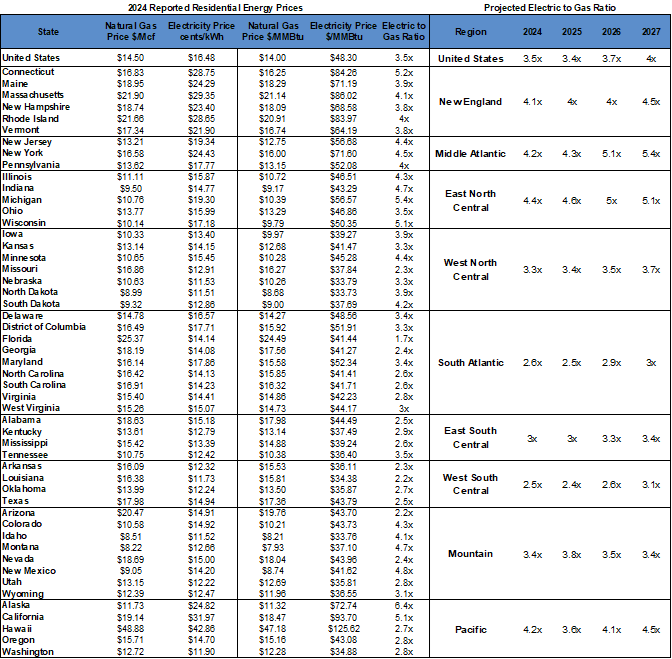
- All Census regions except the Mountain region show a widening electricity-to-gas price gap. STEO does not publish state-level price projections, but if the trend continues, states could generally move in the same direction on average. The Northeast shows the widest gap between electricity and natural gas prices, with the regional average ratio projected to reach 4.5x in 2027. Several states (e.g., PA, NY, NJ, CT) already show similar ratios in 2024.
- Southern states generally have lower electricity-to-gas price ratios than most northern states, although some are still near 3x in 2024 (e.g., KY, TN, OK). Even so, EIA projects the South’s ratio to widen the most among major Census regions, increasing about 14% by 2027 as electricity prices rise relative to natural gas.
Reported State Energy Prices and Regional Projections
Source: EIA Short Term Energy Outlook, March 10, 2026 // AGA Contact: Brendan O’Brien (bobrien@aga.org) 202-824-7220
Notice
In issuing and making this publication available, AGA is not undertaking to render professional or other services for or on behalf of any person or entity. Nor is AGA undertaking to perform any duty owed by any person or entity to someone else. Anyone using this document should rely on his or her own independent judgment or, as appropriate, seek the advice of a competent professional in determining the exercise of reasonable care in any given circumstances. The statements in this publication are for general information and represent an unaudited compilation of statistical information that could contain coding or processing errors. AGA makes no warranties, express or implied, nor representations about the accuracy of the information in the publication or its appropriateness for any given purpose or situation. This publication shall not be construed as including advice, guidance, or recommendations to take, or not to take, regarding any matter, including without limitation relating to investments or the purchase or sale of any securities, shares or other assets of any kind. Should you take any such action or decision; you do so at your own risk. Information on the topics covered by this publication may be available from other sources, which the user may wish to consult for additional views or information not covered by this publication.
Copyright © 2026 American Gas Association. All rights reserved.