Natural Gas Utilities Continue to Grow
Key National Trends
- More than 73.7 million U.S. households received residential natural gas service in 2024, according to EIA data, highlighting the continued scale and importance of natural gas in meeting residential energy needs nationwide.
- 586,796 net new residential natural gas consumers were added between 2023 and 2024, reflecting continued growth in residential natural gas services.
- California (11.4 million), Texas (5.3 million), and New York (4.6 million) remain the largest residential natural gas markets in the country, serving millions of households across their utility networks.
Long-Term Growth Trends (2014-2024)
- U.S. residential natural gas consumers grew from 67.2 million in 2014 to 73.7 million in 2024, adding approximately 6.5 million households over the past decade. This represents a compound annual growth rate (CAGR) of roughly 0.9% nationwide, reflecting steady long-term expansion of residential natural gas services.
- Texas (+839,423), California (+646,916), and North Carolina (+261,201), recorded the largest increases in residential natural gas consumers between 2014 and 2024.
State-Level Highlights
| Rank | State | Total net Growth (2014–2024) | CAGR – 10Y |
|---|---|---|---|
| 1 | Texas | 839,423 | 1.7% |
| 2 | California | 646,916 | 0.6% |
| 3 | North Carolina | 261,201 | 2% |
| 4 | Michigan | 248,660 | 0.8% |
| 5 | Colorado | 247,399 | 1.4% |
| 6 | Utah | 233,903 | 2.4% |
Fuel Choice Legislation
Fuel choice laws protect consumer access to natural gas by preventing local governments from banning natural gas connections in new construction. As of 2026, 27 states have adopted fuel choice protections. Of the top six states for residential gas growth since 2014, Texas and Utah have enacted fuel choice laws, while California, North Carolina, Michigan, and Colorado have not. This suggests that while fuel choice policies can help maintain access to natural gas, population growth, housing development, and regional economic trends also play an important role in shaping residential energy demand.
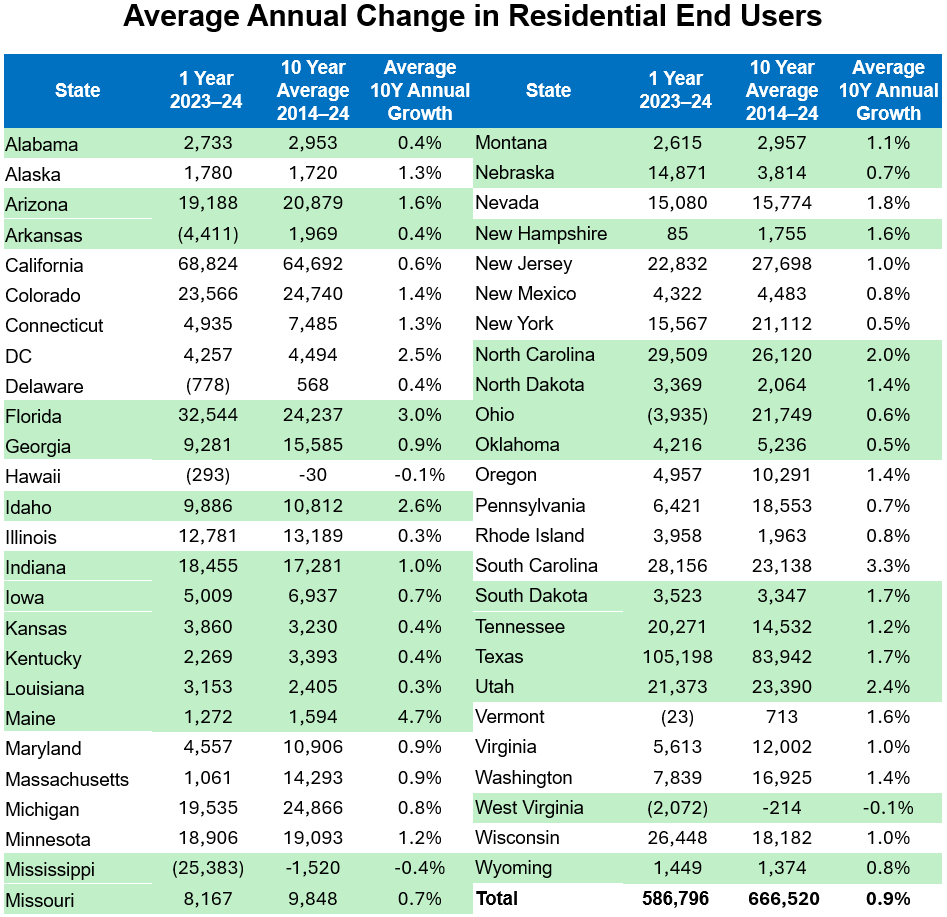
*Green highlight indicates states with fuel choice legislation
Source: Energy Information Administration EIA-176 Survey
AGA Contact: Brendan O’Brien | bobrien@aga.org | 202-824-7220, Maggie Liu | mliu@aga.org | 202-824-7000
Notice: In issuing and making this publication available, AGA is not undertaking to render professional or other services for or on behalf of any person or entity. Nor is AGA undertaking to perform any duty owed by any person or entity to someone else. Anyone using this document should rely on his or her own independent judgment or, as appropriate, seek the advice of a competent professional in determining the exercise of reasonable care in any given circumstances. The statements in this publication are for general information and represent an unaudited compilation of statistical information that could contain coding or processing errors. AGA makes no warranties, express or implied, nor representations about the accuracy of the information in the publication or its appropriateness for any given purpose or situation. This publication shall not be construed as including advice, guidance, or recommendations to take, or not to take, regarding any matter, including without limitation relating to investments or the purchase or sale of any securities, shares or other assets of any kind. Should you take any such action or decision; you do so at your own risk. Information on the topics covered by this publication may be available from other sources, which the user may wish to consult for additional views or information not covered by this publication.
Copyright © 2026 American Gas Association. All rights reserved