Building for Growth
By M. Diane McCormick
Wherever there’s growth, natural gas is leading the way.
Across the U.S., strategic infrastructure investments are positioning natural gas as a driver of economic prosperity. Expansion and modernization projects are meeting the energy needs of rising populations while equipping industries to forge ahead through reliable supplies of safe, affordable natural gas.
Consider PG&E’s complex upgrade of a station at the core of its system. “This,” says construction executive Kevin Armato, “is an example of how we’re investing in natural gas infrastructure and really expecting large gas growth.”
It’s just one of many projects demonstrating the foresight of natural gas utilities and their plans to fuel a growing nation.
West Coast: PG&E’s Modernization Project
In Fresno County, California, PG&E’s northern and southern gas-supply paths converge to form a critical part of the state’s gas-transmission backbone at Panoche Station in California’s Central Valley.
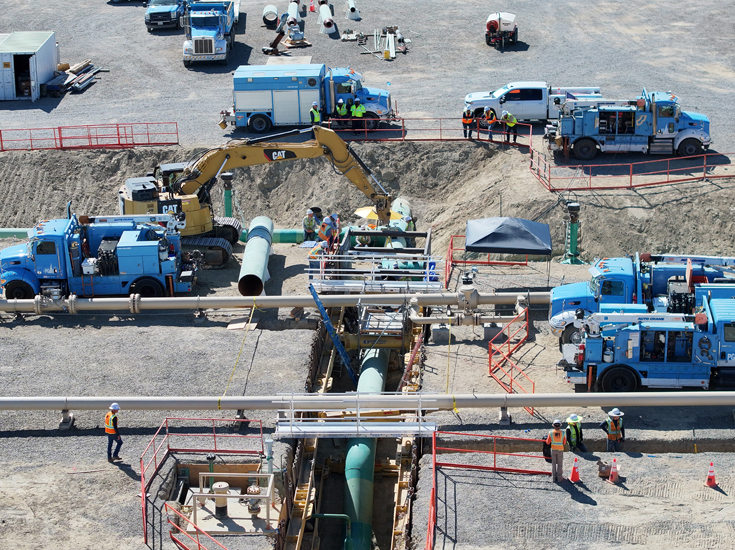
PG&E needed to upgrade the heart of its system without interrupting service and successfully completed the $32 million project in spring 2026. After 10 years of planning and application of 13 carefully sequenced clearances, PG&E finished the job in 20 months, upgrading a 20th-century station to meet 21st-century demand.
“In a perfect world, we’d isolate everything, clear everything and begin construction,” said Hanibal Shamoeil, natural gas transmission construction director for PG&E’s south region. “We didn’t have that opportunity here, so we had years and years of planning. How do we sectionalize this area to ensure the safety of the men and women that are working on the pipeline, and how do we make sure we continue to maintain downstream reliability to our customers?”
Since its origins in the 1950s, Panoche Station has become central to operations as the juncture of two pipelines, one moving natural gas north from central New Mexico and Texas and the other moving gas south from the Canada-Oregon border. “It can be used to supplement south and north gas to provide that flow to the Bay Area, where a majority of our customers are,” said Armato, vice president of gas transmission and distribution construction.
PG&E’s plans called for flexibility to serve the region with natural gas supplies coming from either north or south while meeting rising demand from large commercial customers, including data centers that may generate power on-site using fuel cells or turbines.
The utility strategically phased its project clearances—formal safety controls used to isolate, depressurize and secure specific facilities while other portions of the station remained operational—to “rebuild in appropriate sequencing,” said Shamoeil. The process included stringent lockout/tagout procedures, walkdowns to verify correct valve positioning, depressurization and repeated after-action reviews.
Sectionalization was aided by the northbound pipeline’s dual A and B lines, allowing natural gas flow to be rerouted from a line taken out of service for construction. “Our planning team and our engineering team worked and built the best-case scenario on how we were going to isolate, what we would cap off, and then return to service with new caps on it while we isolated another section of the line,” he added.
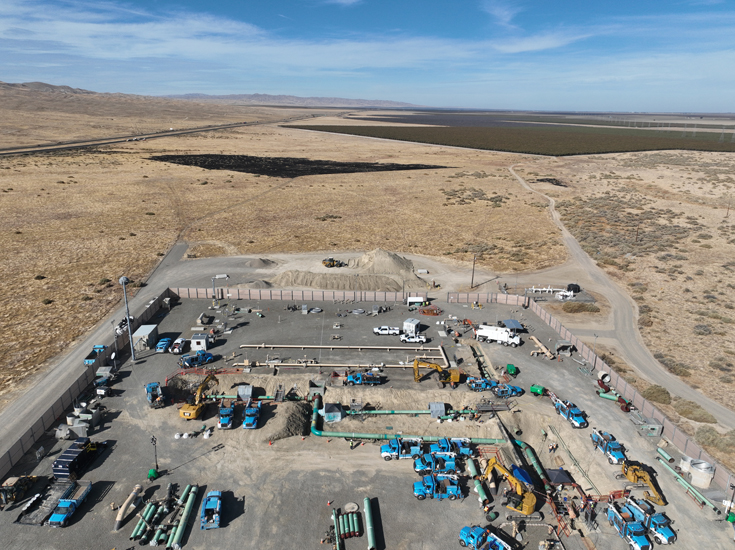
With the project’s completion, automation and control technology have created “the station of the future,” said Shamoeil. The improvements provide gas control operators with real-time visibility to make remote adjustments in “a very dynamic environment,” strengthening reliability and supporting more effective responses during emergency and natural disaster situations.
The upgrades also equip the station to receive all the renewable natural gas coming into the system from the region’s numerous RNG facilities and transport it to end-use customers—“a real opportunity for us,” said Armato.
The modernized station “sets us up for the future of additional gas requests coming onto our system and continuing gas flow without any interruption,” Armato added. “We can continue to be trustworthy with our customers, who know that their gas is always there when they need it and always available because we have the reliability and the capacity.”
East Coast: Making STRIDEs
In 2013, Maryland enacted the Strategic Infrastructure Development and Enhancement Plan, or STRIDE, to accelerate pipeline replacement. STRIDE allows Maryland gas utilities to recover project costs in real time through surcharges capped at $2 per month per residential customer and variable rates for others.
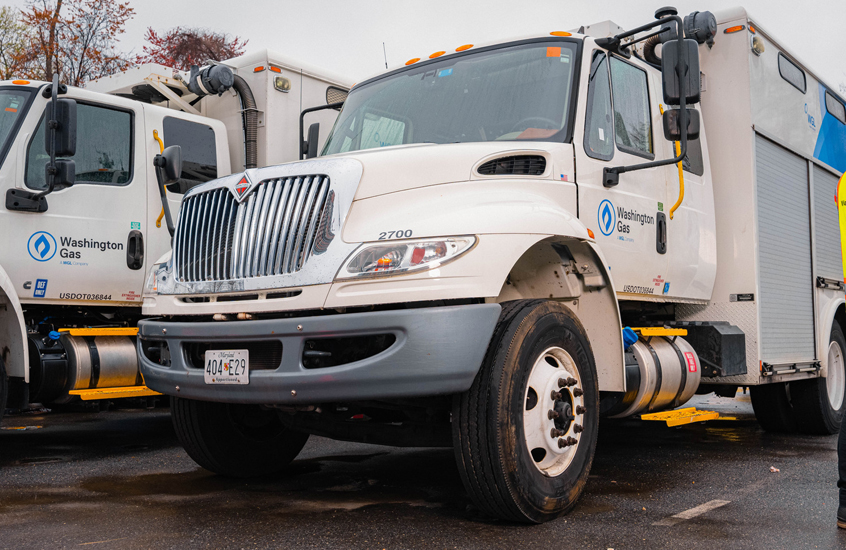
Through 2025, Washington Gas has leveraged the program for safety, reliability and diminished greenhouse gas emissions, replacing more than 161 miles of main and about 33,400 services while reducing emissions by 45%.
With each five-year STRIDE filing with the Public Service Commission of Maryland, Washington Gas implements critical infrastructure upgrades in parallel with its major capital program, said Director of Regulatory Affairs Andrew Lawson.
Washington Gas’ first STRIDE plan targeted bare and unprotected steel, cast iron and midcentury-era mechanically coupled pipe known to have joint issues. STRIDE 2, launched in 2018, expanded to include replacement of high-pressure pipes, valves and transmission facilities. While bare, unprotected steel pipes remain a target until all are replaced, STRIDE 3, authorized through 2028, is taking the added step of replacing low-pressure assets.
As STRIDE has expanded, Washington Gas has adopted risk modeling to prioritize and schedule projects, Lawson said. Using JANA Lighthouse software, the utility now assesses internal leak and incident data and analyzes potential health, safety and property damage. The approach balances risk reduction against costs, allocating STRIDE funds for maximum impact. “We’re certainly looking to keep costs down,” said Lawson. “You don’t want to replace every component of the system, but the commission … approved this additional program of replacing low-pressure pipes.”
With every service put in place, Washington Gas updates mapping and installs any needed excess-flow valves, exterior meters, and marker balls or tracers for easier locating. “You get ancillary safety benefits that are greater than just a swap of the old material for new material,” Lawson said.
Midwest: Boosting Affordability
In June, the U.S. Department of Energy’s Office of Energy Dominance Financing announced a $1.6 billion loan to DTE Gas Company for modernizing natural gas infrastructure and lowering electricity prices.
The loan saves Michigan customers more than $700 million in interest. The DOE “is lowering energy costs and ensuring the American people have access to affordable, reliable and secure energy,” Energy Secretary Chris Wright stated in announcing the loan.
DTE Gas is “always looking for innovative ways to keep costs as low as possible for our customers” and was pleased to work with the DOE to secure the loan, “which will ultimately help us keep natural gas service safe, reliable and affordable for customers,” said Renee Tomina, DTE Gas president and chief operating officer.
The loan will help fund DTE’s natural gas pipeline renewal program, an ongoing project that will upgrade 800 miles from 2027 through mid-2031. Plans also include upgrading a Michigan compressor station where natural gas stored in underground reservoirs helps ensure affordable supplies during peak demand.
The complete project will help strengthen DTE’s delivery system while reducing annual greenhouse gas emissions by an estimated 500,000 metric tons of CO2e (carbon dioxide equivalent).
“When complete, all the work the loan is funding will help us ensure that when families turn on their hot water, start their clothes dryers or dial up their thermostats to stay comfortable on cold days, they won’t have to think about whether the natural gas will be there for them—because DTE makes sure that it always is,” said Tomina.
Around the Map: Where the Growth Is
Natural gas utilities continue to invest in infrastructure across the United States to anticipate future demand and support growth in rapidly expanding regions.
Desert Southwest Pipeline: As the population of Arizona and New Mexico keeps growing and existing natural gas pipelines are fully subscribed, Energy Transfer is planning its Desert Southwest expansion of its Transwestern Pipeline. Starting at Winkler County in West Texas, the 48-inch underground pipeline will travel about 520 miles to its Coolidge, Arizona, endpoint.
Nine new compressor stations will deliver up to 2.3 billion cubic feet per day of natural gas from the Permian Basin to customers in Texas, New Mexico and Arizona. Bidirectional capabilities added to Transwestern’s Phoenix Lateral will allow supplies to move according to need.
The project increases natural gas supply for electrical generation capacity while providing “year-round, reliable economic supplies” to support the energy needs of utilities and energy providers in a region where the population and economy are growing, according to Energy Transfer.
Construction is expected to start in the second quarter of 2028 and conclude with service in the fourth quarter of 2029.
New Mexico Natural Gas is among the utilities benefiting from “the redundancy in supply and delivery options from multiple pipelines, which will provide significant capabilities with regard to reliability,” said spokesman Tim Korte. “Also, the additional capacity will ensure the ability to serve future peak loads and provide opportunities for customer load growth.”
Florida Energy Pathway: To serve Florida’s growing south, Chesapeake Utilities Corporation and its Peninsula Pipeline Company subsidiary have proposed the Florida Energy Pathway. Under the plan, PPC will develop, build and operate the pipeline expansion to address regional supply constraints, enhance system reliability and extend natural gas infrastructure to serve homes and businesses.
The 24-inch FEP pipeline is expected to originate in Palm Beach County and terminate in Miami-Dade County. According to Chesapeake, firm commitments totaling 250,000 dekatherms per day from investment-grade shippers anchor the project.
“Florida continues to lead the nation in population and economic growth, which drives increasing energy demand,” said Jeff Householder, Chesapeake Utilities board chair, president and CEO. “In the south Florida area, this has led to significant energy supply constraints. Natural gas infrastructure expansions, including the Florida Energy Pathway project, play an important role in enabling regional growth, increasing natural gas capacity and supporting long-term energy independence.”
Southeast Supply Enhancement: The nation’s largest-volume natural gas pipeline system is getting larger, as Williams expands its Transco pipeline capacity.
The Southeast Supply Enhancement project includes construction of pipeline looping adjacent to the existing Transco corridor and modifying eight facilities, according to Williams. It is designed to meet growing residential, commercial and industrial demand in Virginia, North Carolina, South Carolina, Georgia and Alabama.
“By adding approximately 1.6 million dekatherms per day of transportation capacity, the project will help improve energy reliability, support economic growth, and provide access to affordable natural gas supplies for homes, businesses and manufacturers across the region,” said Cherice Corley, Williams spokesperson.
Construction began in March 2026 and is on track to reach its scheduled 2027 third-quarter in-service date, Corley said.