Closing the Communication Gap
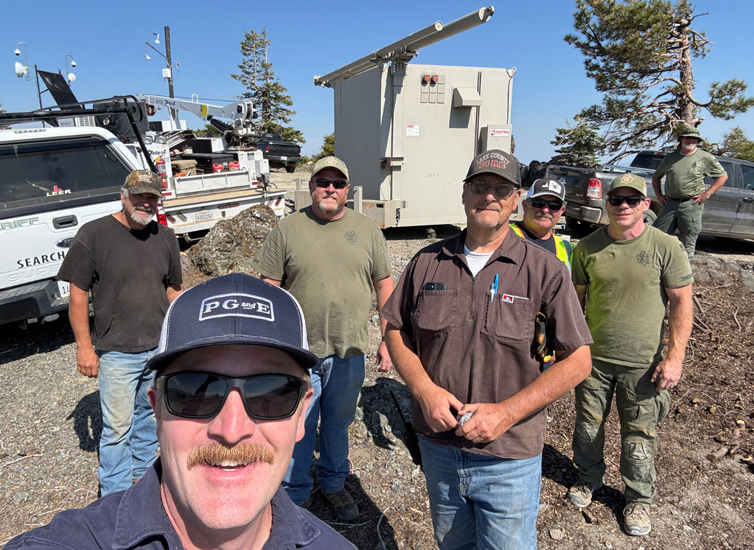
Closing the Communication Gap
For nearly 14 years, first responders in eastern Lake County faced a life-threatening challenge: an emergency communications dead zone. The region, one of the most economically disadvantaged areas in PG&E’s service territory, had long struggled with pockets where radio and cell signals simply vanished.
“Throughout eastern Lake County, there were dead spots where you couldn’t reach anyone from the outside world— no radio, no cell phone service,” said PG&E Public Safety Specialist Donovan Lee. “When you work in the field, communication is key, and in fire country, it’s an absolute imperative.”
Local officials recognized the risks. After extensive research, the county identified a best-fit solution: a mountaintop communications vault and repeater on Goat Mountain, designed to boost signal strength and extend coverage across multiple counties.
The stumbling block? Getting the vault there.
The structure was too large and heavy for the rugged, unpaved summit roads. A helicopter was the only viable transport option, but the cost was well beyond the county’s budget. For more than a decade, the project remained stuck.
The turning point came during a 2024 wildfire response in Lakeport. PG&E Public Safety Specialist Ron Karlen was on-site assisting with the incident when he spoke with Lake County Fire Chief Willy Supina about the long-stalled communications project.
Karlen escalated the issue to PG&E North Coast Region Vice President Dave Canny, who immediately recognized both the safety imperative and the impact on PG&E customers. “This was a great opportunity to support our first responder partners and address a clear safety gap impacting PG&E customers,” Canny said. “We delivered for our hometowns on multiple fronts.”
PG&E developed a plan: While it couldn’t donate a helicopter outright, it could provide one at a significantly discounted rate. That level of support made the project financially reachable for Lake County and the Lake County Fire Chiefs Association.
Weather-related delays and a last-minute aircraft change complicated the timeline, but PG&E honored its commitment by securing a reduced-rate helicopter from longtime partner PJ Helicopters. The collaboration was seamless.
“From the PG&E perspective, our public safety and safety and infrastructure protection teams use those radio frequencies to get fire status and other critical information,” said PG&E senior manager Brian Gerving. “It was a win-win for both of us from a business and safety perspective.”
On June 9, 2025, the operation finally came together. The vault was trucked to a nearby campground, where a helicopter hoisted the massive structure to the summit. A ground team made a strenuous 2.5-hour hike to meet the delivery and complete the installation.
For Chief Supina, who had spent more than a decade searching for a solution, the moment was emotional. “I can retire now. I can retire happy,” he said. “This is such a relief for me personally to complete this project. It was as good as the day my kids were born.”
The new repeater went online in the fall, in time for peak fire season. It’s dramatically improving emergency communication across at least four counties, strengthening coordination and response for the region’s first responders.
PG&E’s experience provides several takeaways for utilities facing similar regional or cross-agency challenges:
1. Small safety gaps can have outsized impact. Utilities should routinely evaluate low-visibility vulnerabilities that may not involve core assets but still create systemic risk.
2. Field-level conversations matter. Utilities benefit when frontline employees feel empowered to raise recurring pain points and longstanding community safety hurdles.
3. Creative partnerships stretch limited budgets. Not every public agency can fund expensive specialized equipment. Even modest support can transform a stalled project into an achievable one. Utilities can play a catalytic role by:
- Offering discounted access to in-house resources,
- Negotiating reduced rates through trusted vendors, or
- Coordinating multi-agency partnerships to distribute costs.
4. Local relationships build long-term resilience. The collaboration between PG&E, local fire chiefs, the forest service and aerial partners shows the power of regional networks. Investing in these relationships before an emergency provides shared benefits for both utilities and communities.
5. Agility accelerates safety improvements. Once engaged, PG&E helped move a 12-year project to completion in only six months. Utilities that can pivot quickly—despite weather shifts, equipment changes, or permitting challenges—can deliver critical safety improvements far faster than agencies working alone.