From Classroom to Community
From Classroom to Community
For natural gas utilities seeking ways to connect with their communities beyond pipelines, meters and bills, Washington Gas offers a compelling strategy: Its sponsorship of the WUSA9 Eco Challenge, a contest for middle-school environmental projects, demonstrates how utilities can foster goodwill, support innovation and encourage early ecological stewardship.
“The Eco Challenge showcases the power of young people to not only imagine, but to build a cleaner future,” said Blue Jenkins, president of Washington Gas.
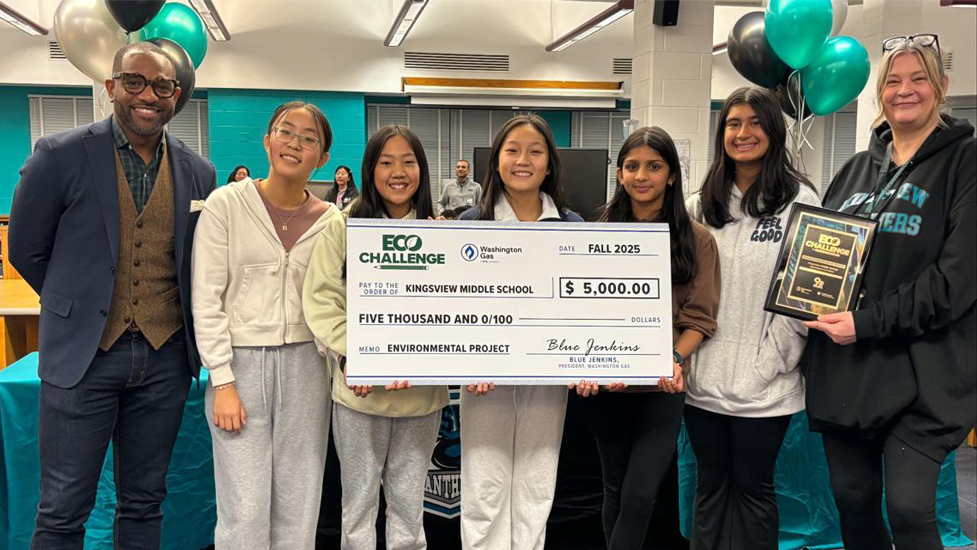
Washington Gas, in partnership with local broadcaster WUSA9, backs the contest financially and institutionally. The Eco Challenge invites middle school teachers in the Washington, D.C. metro area to submit proposals for student-led environmental projects. Each year, a handful of schools are selected to win a $5,000 grant to bring the student projects to life. Moreover, winners receive ongoing educational support through materials and programming provided by the Smithsonian Science Education Center.
In 2025, two schools won: Kingsview Middle School in Montgomery County, Maryland, which is creating a solar-powered hydroponic greenhouse that combines renewable energy with sustainable agriculture, and John Hanson Middle School in Charles County, Maryland, which is developing an outdoor classroom within a student-created wetland featuring native plants and runoff systems to protect local waterways.
By funding grassroots ecological projects like the WUSA9 Eco Challenge, Washington Gas goes beyond energy delivery, earning a position as a partner in environmental and community wellbeing. For natural gas utilities elsewhere, this suggests a path to earn trust and “social license,” not just through reliable service, but by contributing to the local environmental and educational future.
The contest also empowers youth and local engagement by encouraging middle school students—often among the earliest age groups taught about climate, conservation and civic responsibility—to lead real-world environmental projects. That builds agency, environmental awareness and community involvement, while further associating the sponsoring utility with positive values rather than just consumption. “Seeing these students bring bold ideas to life reminds us that our future is in very capable hands,” Jenkins said.
The results are tangible. Projects such as community gardens, pollinator habitats, composting systems or outdoor classrooms create visible change in schoolyards and neighborhoods, giving communities something concrete to point to and be proud of. “Their dedication to bringing their projects to life strengthens our commitment to the communities we serve,” Jenkins added.
Crucially, the Smithsonian Science Education Center’s ongoing educational support demonstrates an ongoing commitment to learning, rather than a one-off gesture. This model encourages legitimacy and long-term impact, something utilities aiming for genuine community engagement should emulate.
The WUSA9 Eco Challenge offers a blueprint for how energy utilities can engage communities positively, support environmental stewardship, and build trust. Utilities interested in emulating something similar can consider the following:
- Sponsor youth- or school-based environmental contests or grants, giving small- to mid-scale funding for sustainability projects.
- Pair financial support with educational resources (e.g., curriculum support, workshops, expert partnerships), not just a check.
- Highlight and publicize winners in local media to reinforce community goodwill and transparency.
- Encourage projects that deliver tangible, local impact (gardens, composting, green spaces, biodiversity, energy/water-saving initiatives) rather than abstract concepts.
- Develop a program that shows the utility values environmental stewardship and community well-being, not just energy delivery.
As the energy sector evolves and public interest in sustainability grows, programs like WUSA9 Eco Challenge could become increasingly relevant and valuable. By supporting youth-driven sustainability efforts, utilities can shift part of the narrative around their role in local communities: from energy provider to environmental partner.