Innovation at the Ready
By Thomas A. Barstow
Innovation doesn’t happen in a vacuum. It happens when customer service representatives spot a pain point affecting consumers. It comes when employees ask for a solution to a common problem. It plays a role when workers decide there has to be a better way to do a routine task.
Innovation sometimes comes with a spotlight and fanfare, but often the best innovations are those that help employees do the tasks they must do every day better, easier and more effectively. And for these natural gas utilities, those ideas started from the bottom up.

Duke Energy: Adding AI to its Anti-Scam Arsenal
At Duke Energy, customers reported thousands of scams across its service areas in 2025, with a notable spike in February of last year, when many customers sought bill assistance. One such scam involved a paid search ad impersonating the company with a bogus customer service number, the North Carolina company said in a news release.
The company now uses AI to identify and combat online schemes targeting customers. AI scans digital channels such as websites, social media and paid advertisements for open‑source social‑engineering threats—including fake ads and impostor helplines—and flags them for removal with the hosting platforms.
While this work continues, Duke also partnered with the Better Business Bureau and other utilities in November for the 10th annual Utility Scam Awareness Day, broadly sharing news releases across its territories to help customers slow down, verify and stop scams. Advice included noting red flags that indicate a scam, such as demands for immediate payment, threats to cut off service or insistence on prepaid cards or cryptocurrency. “The company will never specify how you must pay or threaten instant disconnection,” Duke told consumers.
“As scammers become more sophisticated, Duke Energy is proactively working to protect customers from bad actors,” said Jessica Bishop, the company’s senior vice president of customer service operations. “Our commitment is to protect our communities and create a secure platform when managing their energy account.”
BGE: ‘Gas GPT, How Do I…?’
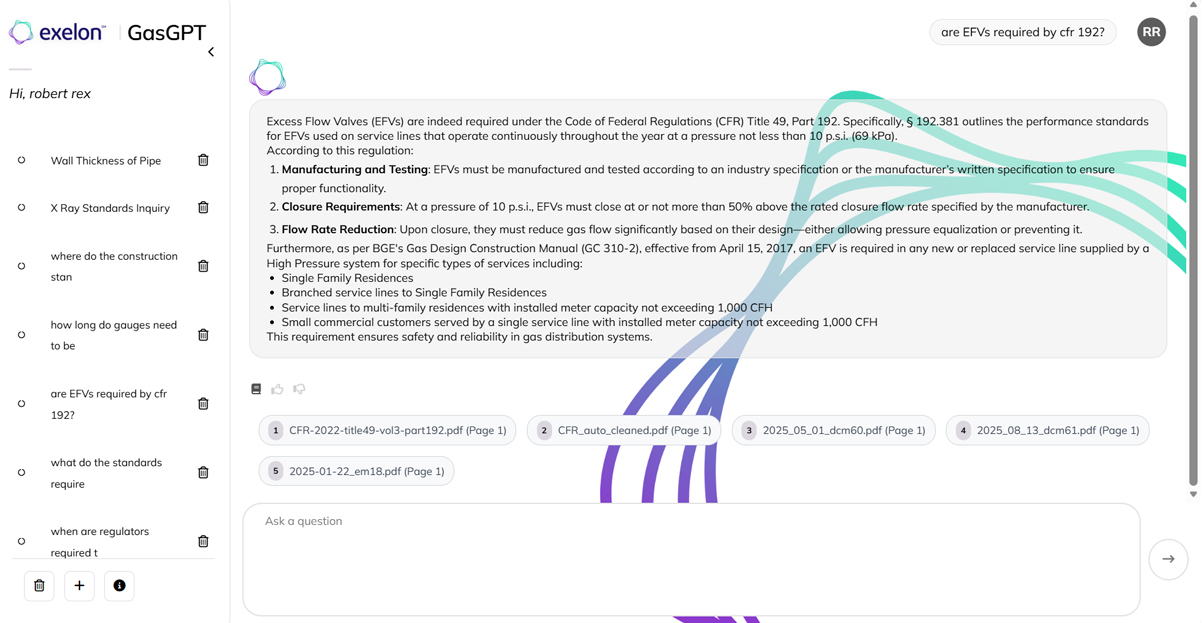
Like Duke, Baltimore Gas and Electric wanted to tap AI’s potential. During an Innovation Ideation session in August 2023, several workers suggested using AI to improve operations by developing and training a chatbot that could help workers easily find answers to specific questions.
“I am a little bit of a nerd when it comes to AI, and I try to keep my finger on the pulse,” said Robert Rex, senior manager gas engineering and asset performance at BGE. “But I am by no means an expert.”
Rex became part of a group of like-minded engineers and data analytics experts who delved into the project. The team from BGE and its parent company, Exelon, also included Nolan Aberdeen, general engineer at Exelon; Bobby Besharati, senior manager, advanced analytics, at Exelon; Malcolm Lewis, BGE engineering manager; and Michael Warren, principal quant engineer and the lead for the AI product.
Their AI tool—eventually dubbed Gas GPT—provides a secure environment where employees can sort through vast volumes of information found in the company’s guides, reports and manuals, such as gas construction standards, engineering standards, the Transmission Integrity Management Program, the Distribution Integrity Management Program and the Gas Emergency Plan.
“The construction standards alone are 1,700 pages,” Rex said. A keyword search of that one document might return more than 1,000 hits, leading to a painstaking process to find the right passage. However, Gas GPT has been trained to pinpoint relevant sections after users ask direct questions.
Developing the chatbot involved entering more than 3,000 pages into the platform. The team members then tried to break the chatbot, Rex said, by asking Gas GPT questions intended to confuse it. In doing so, they were able to identify and shore up weaknesses.
At times, subject-matter experts also found the new tool had provided an incorrect answer, only to later discover that they themselves didn’t have the most up-to-date information and that Gas GPT had been correct. Such insights demonstrated how the chatbot could highlight obsolete data, confusing wording or contradictory information in the original documents.
Gas GPT now answers up to 400 questions per month from about 50 distinct users. “It took us six months to get it set up, and it probably took us a year to get to where we felt confident in it,” Rex said. “It takes time. It’s not something you sign up to do for a week and it’s in place and it works. It’s a commitment.”
Last year, the team added “like” and “dislike” buttons for quicker feedback, encouraging users not to be shy about pushing “dislike” to alert developers to issues.
Training and education are clear benefits. Newer workers tend to hesitate before asking questions of their busy seasoned colleagues, Rex pointed out. Gas GPT can serve as a virtual colleague, with workers able to bounce questions and ideas off it, saving time in the process. That initial virtual discussion saves time for busy co-workers, too. The team also looks for recurring questions from both new and experienced workers that might spark a higher-level discussion about standards or technical matters.
Over time, Gas GPT might develop deep expertise, allowing workers to kick around complex ideas and solve difficult problems. As it is now, the chatbot’s answers will prompt new questions, leading people to discuss what they learned or misunderstood. “And that’s awesome,” Rex said. “It’s driving conversation and a little bit of debate.”
One caution: Users must ensure they are getting accurate information. “Don’t make safety-related decisions on this,” Rex said. “People still need to check to make sure what they are getting is correct.”
On the flip side, Gas GPT could also be used to check an employee’s work. For instance, engineers must perform numerous calculations such as how much water is required for a transmission job. The calculation is easy for a trained engineer, but running it through Gas GPT can double-check the thinking.
While the team has uploaded about 10 batches of materials so far, it is continuing to add more documents. Eventually, that could greatly increase, requiring a plan for ensuring the tool stays current.
The effort likely will be worth it, Rex said. Cost savings aren’t straightforward because they involve calculating time through the lens of an individual’s work habits, he added. But as workers routinely look up critical information in a few seconds or minutes instead of hours, the savings will mount. And much has been learned, updated and corrected, too.
“It was the first chatbot of its kind at our company, and it is fun being on the cutting edge,” Rex said. “Everybody on the team is passionate about new, innovative ideas.”
Ameren Illinois: Homegrown Innovation for Pigging and Pickling Operations
The Federal Energy Regulatory Commission requires utilities to assess pipelines every seven years, a time-consuming and costly process. The heavy equipment required for the work also creates a higher risk for lift injuries.
“Historically, our teams have had to carry a bunch of equipment from site to site. And there are a lot of cords, oftentimes going from their vehicles, connecting to what they need from the pipeline,” Kamnick said. “It was becoming a burden for the staff.”
It was that situation that led SCADA Technician Kyle Johnson to seek funding from Ameren’s engineering department to find an easier way for workers to do their jobs. An Ameren employee for more than 15 years, Johnson studied electrical control technology at Carl Sandburg College in Galesburg, Illinois.
“He is our most innovative SCADA technician,” Kamnick said. “He takes a look at the job and asks, ‘Are we using an outdated process? How can we be more efficient? What’s going to ease the load or ease the burden for this task?’”
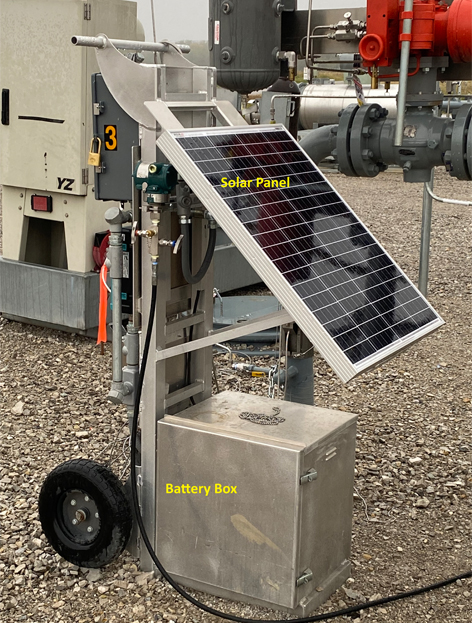
The Flexim Cart—a portable cart that measures flow rates and transmits data to gas control during pigging and pickling operations—was the answer to those questions. The prototype performed so well that Ameren built several more, deploying them in 2025 in remote locations that lack fixed monitoring capabilities and electricity. Working with Johnson were Josh Hill, who co-created the cart, and Mike Pulke and Trevor Kurlbaum, who built and used the additional units, Kamnick said.
Hand trucks—like those used to lift, push and move an appliance—create portability, and measurement tools and a solar panel are latched on.The flow computer and the Supervisory Control and Data Acquisition, or SCADA, equipment measure flow rate and, if needed, furnish a flow signal to a portable odorizer that helps regulate the right amounts of mercaptan. The cellular component transmits data back to gas control for real-time monitoring of the flow rate, odorant injection rate and odorizer alarms. The carts also run on solar panels, allowing technicians to “set and forget” them, freeing workers to move onto other tasks or job sites.
“With the set-it-and-forget-it aspect, nobody really needs to be there to monitor it because it’s feeding this information to our gas control center,” Kamnick said. “It can be used for pigging but also for the pickling process, and our regional engineers are excited about that benefit, too.”
The benefits were seen right away. A typical three-day inline inspection (ILI) run— also known as pigging—requires at least 30 hours of manpower to transport, set up and monitor. “Using a cart, the manpower was reduced to approximately eight hours for transport and setup to send data to gas control, with no monitoring needed,” Kamnick said.
The carts also add visibility for gas control so runs can be accurately controlled to collect valid data, making re-runs less likely. “If the ILI run goes longer, the cart does not require additional hours, whereas the old solution would need to be monitored continuously during the project,” said Kamnick.
Each cart costs roughly $40,000, Kamnick said, adding that the investment is easily covered by the savings in time and manpower. Deployments have continued to ramp up this year, with additional applications being considered, as well.
“It seems like the more people we make aware of this concept, the more ideas are generated,” Kamnick said. Meanwhile, the design is also being shared with American Gas Association members. “We expect a lot more ideas to be generated.”
Brad Kloeppel, senior director of gas operations for Ameren Illinois, noted that everyone at Ameren is encouraged to think of ways to innovate.
“The best ideas often don’t come from the top—they come from the bottom up,” Kloeppel said. “We would not be aware of these opportunities if we didn’t have good employees who brought these great ideas forward so that we can allocate dollars and resources to see these to fruition.”