Ready to Compete
Ready to Compete
In today’s economic development environment, speed matters.
Communities competing for new industrial facilities, advanced manufacturing plants or logistics hubs often have a short window to identify and present a viable location for a project. Meanwhile, companies want certainty, they want realistic timelines, and increasingly, they want pre-identified properties where due diligence has already been completed.
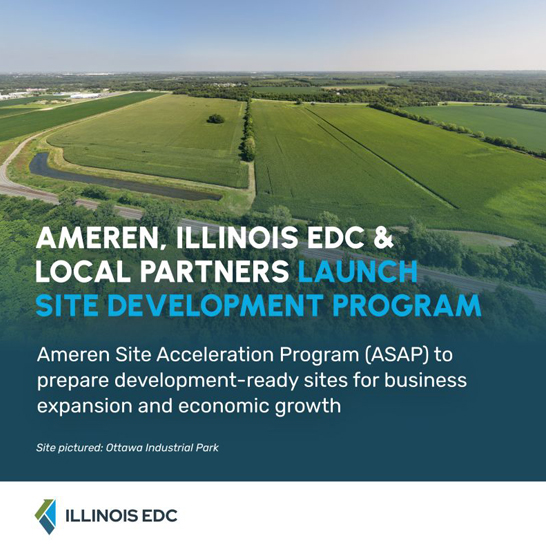
Recognizing this shift, Ameren Illinois, the Illinois Economic Development Corporation and local economic development partners have launched the Ameren Site Acceleration Program or ASAP —an initiative designed to prepare prime development-ready sites in economically disadvantaged areas across downstate Illinois.
The goal is to accelerate development by removing barriers before a prospect ever asks. “Economic development is highly competitive, and the winners cannot afford to be reactive,” said Kristol Simms, vice president of economic development at Ameren Illinois.
Before construction begins on any greenfield property, extensive engineering analyses must confirm soil suitability, infrastructure capacity, environmental conditions and utility availability. Because these studies are costly and time-consuming, in many cases, they are not completed until a company expresses interest, adding months to project timelines.
Through ASAP, those assessments will be completed long before a prospect begins to explore potential locations. The program will fund comprehensive due diligence studies, conceptual site plans, utility capacity evaluations and targeted industry analyses aligned with community strengths. By front-loading this work, Ameren and its partners aim to transform underutilized properties into competitive assets that reduce risk for investors and accelerate business decisions.
According to Ameren, ASAP is not simply about engineering readiness, but also focuses on strategic positioning. For each property, state and local economic development partners will evaluate which industries are best suited to locate there based on available natural gas and electric capacity, transportation access, workforce characteristics and regional economic strengths. Sites will then be marketed to corporate real estate executives and site location consultants through Illinois EDC’s real estate database.
Modern site inventory is increasingly critical to attracting major corporate expansions, said Illinois EDC President and CEO Christy George: “A strong inventory of development-ready sites shortens timelines, reduces risk for investors and strengthens Illinois’ ability to compete.”
The pilot phase of ASAP will focus on three properties in Champaign, Decatur and Ottawa, with engineering studies having begun in January 2026. Each site is located within Ameren’s downstate service territory and listed in Illinois EDC’s property database. Importantly, the program prioritizes “equity investment eligible communities”—areas disproportionately affected by pollution and economic vulnerability. Funding aligns with Illinois’ Climate and Equitable Jobs Act, which emphasizes job creation, clean energy development and economic opportunity in historically underserved regions.
Local leaders see the program as transformative. In Champaign, Mayor Deborah Frank Feinen said participation will strengthen the city’s economic competitiveness. In Decatur, Nicole Bateman of the Economic Development Corporation of Decatur & Macon County emphasized that site readiness puts the community in a leading position for job growth. And in Ottawa, Mayor Robert Hasty noted the initiative will help convert long-standing preparation efforts into tangible investment.
ASAP offers a five-step blueprint for how natural gas utilities can take a proactive role in economic development:
- Do the hard work before the deal exists. Completing environmental reviews, engineering assessments and utility analyses before a prospect even shows interest significantly shortens decision timelines. In a competitive environment, readiness can be the deciding factor.
- Integrate utility capacity into site strategy. Rather than treating energy as a back-end consideration, ASAP evaluates natural gas and electric capacity upfront and matches sites with compatible industries. This ensures realistic marketing and avoids overpromising infrastructure capabilities.
- Partner broadly and early. The collaboration between Ameren Illinois, Illinois EDC and regional economic development organizations demonstrates the power of alignment. Utilities bring infrastructure expertise and funding capacity; state and local partners bring market intelligence and site promotion networks.
- Align with public policy priorities. By targeting equity investment-eligible communities and aligning with CEJA, the program connects economic development with state energy and workforce policy goals—strengthening stakeholder support and access to funding.
- Position the utility as a strategic economic partner. Utilities are uniquely positioned to understand load growth, system capacity and infrastructure timelines. By stepping into a leadership role, Ameren Illinois reinforces the message that energy providers are not just service companies—they are economic development catalysts.
With service to more than 800,000 natural gas customers and 1.2 million electric customers across 1,200 communities, Ameren Illinois’ downstate footprint is vast. Through ASAP, the utility is demonstrating that strategic site preparation can unlock opportunity not only for businesses, but for communities that have historically been left behind. For utilities nationwide facing increasing competition for industrial load growth, the message is clear: Preparation is power.