Setting the Course
By Danielle Wong Moores
As senior vice president of operations at ONE Gas in Tulsa, Oklahoma, Sid McAnnally used to spend an enormous amount of time out in the field: “I’d sit in service centers, drinking coffee after the workday with people who had stories to tell.”
It was a chance to learn the business from the ground up, understanding the challenges and opportunities “in an informal and unguarded way. We were all just focused on solving problems.”
Today, McAnnally still has those kinds of conversations. In many ways, it reminds him of time spent around the kitchen table as a boy listening to his father, who spent his career working at NASA. His father would talk through the NASA approach to problem-solving—breaking down a problem into its incremental parts, understanding each of those parts, and then reconstructing them to discover a successful outcome.
The approach—talking through problems—is in part what McAnnally said has helped him build a successful career in energy.
Now CEO of ONE Gas, McAnnally is still asking questions and seeking input as he steps into the role of the 2026 board chair for the American Gas Association. His focus for the coming year? Continuing to reinforce AGA’s invaluable role in serving its member companies while articulating the key messages of reliability and the need for affordability. Put simply, to highlight the foundational role that natural gas plays in our national energy system.
“People are starting to look at energy in a different way,” he said. “We used to look at natural gas and electricity and all the ways that energy is produced in the United States as siloed. Now, the primacy of reliable and affordable energy is rightly causing all of us to take a look at the interdependence of the energy system in the United States. That new focus draws attention to the foundational role of natural gas, and AGA has a very specific and important part to play in this conversation.”
Beginnings
McAnnally’s father may have worked for NASA, and his mother was a schoolteacher, but the young Sid had a very different idea in mind when it came to his choice of career. “My parents had a really close friend who was a lawyer, and there was another lawyer in my family,” McAnnally said. “Both of those men were influential in helping me think about what public service was like and what a legal career was like, so it was easy to follow their footsteps.”
Originally from north Alabama, McAnnally would attend Auburn University for his undergraduate degree and the University of Alabama School of Law for his Juris Doctorate. His early career was in private practice, primarily litigation, with a couple of stints serving as a policy advisor and staff member for two governors for the state of Alabama, which, he says, helped shape his understanding of governmental and administrative processes.
Later, his practice transitioned to working with CEOs of large publicly traded companies, including energy utilities, concerning legal issues from a reputational or public policy standpoint. One of those utilities was Energen Corporation, the parent company of Alabama Gas Corporation. Its previous CEO was Mike Warren, and like McAnnally, Warren was an alumnus of Auburn University. He had also practiced law before moving into energy and would later serve as board chair for AGA.
Warren had been a mentor since McAnnally’s days as a young lawyer. And it was Warren’s successor who recruited McAnnally—then leading the governmental and regulatory affairs practice group at Maynard, Cooper & Gale, P.C.—to work for him as vice president of external affairs for Energen. “When you’re doing legal work for clients, you come in to solve a very specific problem, but being in an environment where you’re building and growing a business is just a different challenge,” McAnnally said. “It was very attractive then and still is today.”
McAnnally spent five years at Energen—where his responsibilities included governmental affairs at the local, state and federal levels; corporate communications; economic development; and the Energen Foundation—before he was promoted to a senior vice president role and more natural gas-focused work at Alagasco, heading up marketing and customer service.
During that time, he met Pierce Norton, then CEO of ONE Gas, at an AGA board meeting. An offhand conversation with Norton would once again change the course of McAnnally’s career when Norton mentioned he was looking for a new senior vice president of operations. This was in 2014, just after the 100-year-old company had separated from its midstream operations to become one of the nation’s largest gas utilities.
It was an incredible opportunity to learn the operations side of natural gas and align the practices and procedures of ONE Gas’ three subsidiaries: Oklahoma Natural Gas Company, Texas Gas Service and Kansas Gas Service. “We had a seasoned group of operational leaders and were pulling together three separate operating divisions into one company with a common set of core values and goals and allowing people to experience what happens when you align around a set of beliefs,” McAnnally said. “Working with that team allowed us to make a real difference.”
Serving Customers and Communities
Within five years, McAnnally would be promoted to chief operating officer, assuming additional responsibilities for the company’s administrative functions, including human resources, cybersecurity and information technology. That experience allowed him to see how other divisions support operations and ultimately serve customers and communities—an ideal steppingstone when ONE Gas tapped McAnnally as CEO in 2021 after Norton’s retirement.
At the time, McAnnally said, “I’m honored to have the opportunity to lead talented and dedicated employees. Our people’s commitment to providing safe and reliable natural gas service every day makes a difference to our customers and in our communities.”
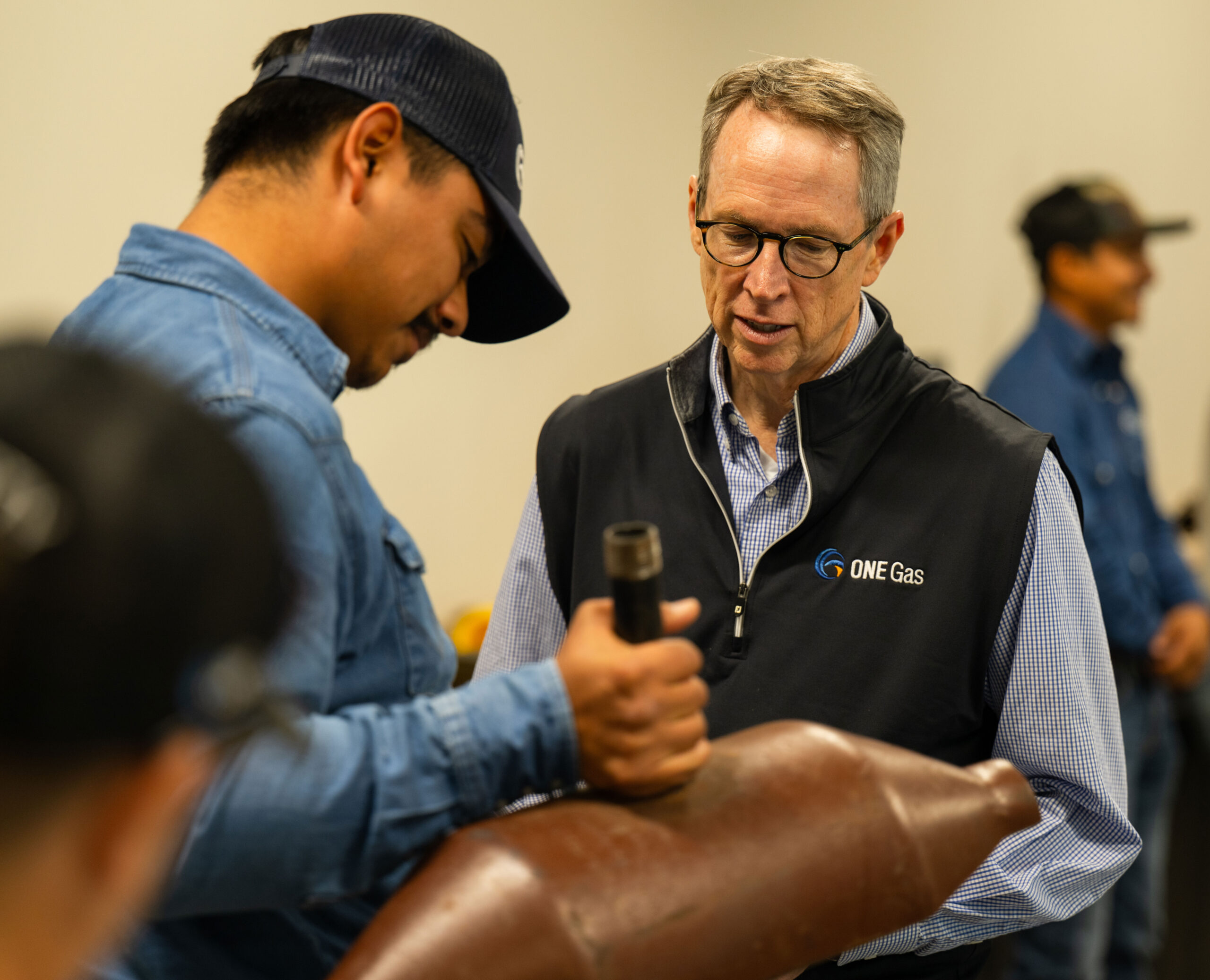
McAnnally saw that commitment in action earlier that year when Winter Storm Uri brought a record-breaking winter storm and cold temperatures across the utility’s entire service area for nearly a week. Thanks to the resilience of the company’s natural gas infrastructure and the dedication of its employees, out of 2.3 million customers across three states, fewer than 800 of ONE Gas’s 2.3 million customers lost natural gas service—most for less than 24 hours. “And we had no serious safety incidents even though the landscape was treacherous with all the ice and extremely cold weather,” he said. “The performance of our team was heroic.”
McAnnally added, “We had to rely on the expertise that people brought to their work, and we had to trust that the core values we had talked about would drive the way people executed their work. We really got to see how being aligned around a set of values drives work in very challenging circumstances.”
Alignment matters in other ways, too. Regions across the United States, like the Midwest and Southeast, are seeing exponential growth. This means utilities must work closely with their local communities and public and private partners—and keep lines of communication open with regulators—to best serve communities, from a safety and reliability standpoint as well as an economic development one. Particularly with large industrial customers, the availability of natural gas promises to create jobs and improve the quality of life for communities. At the same time, utilities have a responsibility to their investors. “That is an underlying commitment I think that all natural gas utilities make to their communities—how can we facilitate economic development in a way that supports both these goals,” he said.
Another challenging balance is the mandate to ensure that high-integrity systems grow in a way that also supports economic growth. For example, McAnnally points to Austin, Texas, one of the nation’s fastest-growing metropolitan areas. ONE Gas is expanding natural gas service into the city to help support that growth and provide a reliable fuel source. “With the right project, it opens up an area for economic development,” he said. “You provide a new source of natural gas to a growing metro area that needs it, and diversification of supply supports the resilience of your system. That’s a great example of the balance we seek to strike.”
Full Circle
McAnnally, who first attended an AGA board meeting as a proxy for his CEO at Energen, is infectiously enthusiastic about his role as 2026 board chair. He is eager to dig deeper into his relationships with member companies and the AGA board and support the staff in their work.
“I think specifically the natural gas industry is unique because it is so collegial,” he said. “Since I first began attending AGA board meetings in 2013, it has been a remarkably collaborative group that is interested in serving customers across the country in a way that causes them to be very supportive and helpful of each other. Most of us don’t compete directly against each other. That allows for a level of peer support that I think is unique in the industry.”
For example, McAnnally is a huge proponent of AGA’s peer review program, which involves participating companies inviting their peers to come onsite to review their operations, share leading safety practices and identify opportunities to better serve customers and communities. Another project he’s proud of being a part of is helping AGA rebuild its strategic planning process, focusing on “the enormous depth of talent we have, not only at the board level but also among leaders across the member companies and the AGA staff. So, we were able to build a process that brings a lot of people into a planning conversation to set the course for AGA.”
In the coming year, McAnnally said it will all go back to having good constructive conversations. He’ll be gathering input from board members on advocating for thoughtful policy. He’ll support AGA staff in their critical work. He’ll continue to ensure board members have a line of sight into the business case for AGA and that everyone understands its value proposition—“because AGA serves a role that member companies don’t have the resources to replicate for themselves.”
Lastly, he will focus on how to best communicate natural gas’s reliability, affordability and resiliency—a message more important now than ever.
“We are all seeking to serve the customers that we’ve made a commitment to,” he said. “These conversations become particularly important as we enter this new energy era, which will require all of us to think differently about the energy system in the United States as a whole, specifically the growing role that natural gas plays. We now have an opportunity to highlight that role as we see growing reliance on how available and affordable natural gas is relative to other energy sources. So, it’s a very exciting time for all of us in the business. But it’s also a time that we have to lean into communicating what we do and why it matters to the communities, the states and the nation we serve.”
A Running Start
When he’s not visiting his grandchildren in North Carolina and Tennessee, you might find Sid McAnnally hip-deep in a mountain stream, casting a line (“fly fishing is all the good parts of golf with none of the bad parts,” he jokes); listening to music “of every possible sort,” from classical to classic country; or reading a good book. “Right now, it’s Apple in China,” he said.
He’s also a runner, but the former musician (who used to play in bands) says he doesn’t have a running playlist that he listens to. Instead, he problem-solves. “It’s a great time to think about a very specific thing and just see what comes into your head as you run,” he said. “You’re a little bit more creative. And it’s sort of unfocused thought, but not thinking about a problem often sparks a new and better idea.”