Training in Precision
Training in Precision
At CenterPoint Energy, innovation doesn’t always come in the form of new equipment or software. Sometimes, it has four legs, a powerful nose and a singular mission: keeping communities safe.
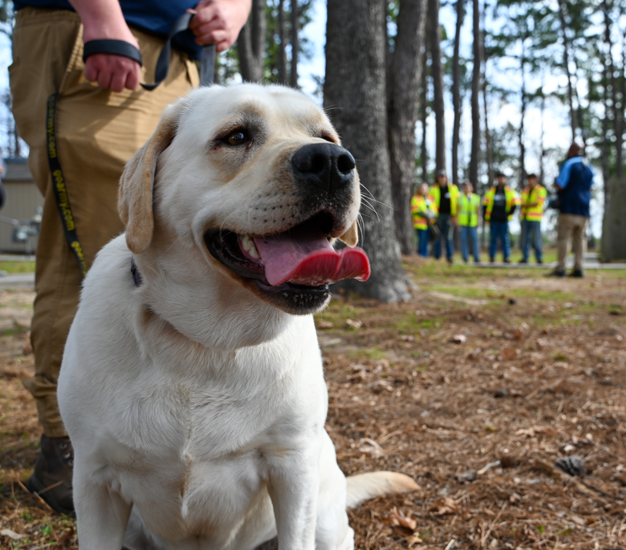
The company’s natural gas emission-detecting K9 team—comprised of Holly, Sunday and Gunner—has become a critical part of its safety operations across the Greater Houston area. Together, these highly trained dogs help detect approximately 60 emissions each week, supporting field crews with speed and precision that traditional methods alone cannot match.
CenterPoint launched its K9 program as part of a broader effort to help enhance emission detection capabilities in densely populated and hard-to-access areas. Urban environments, with their complex infrastructure and competing odors, can present challenges for conventional detection tools. The addition of trained dogs provides a complementary solution, one that is both mobile and highly sensitive.
Handlers and trainers, including K9 specialist Damien Pamplin, work closely with the dogs to integrate them into daily field operations. Over time, the program has evolved into a fully embedded safety resource, deployed across neighborhoods, business districts and critical infrastructure throughout the company’s 12-county Greater Houston service territory.
Each dog undergoes rigorous, specialized training to detect methane, the primary component of natural gas. Using scent discrimination techniques, the dogs are conditioned to identify even trace amounts of gas and signal their handlers when gas is present.
This training is continuous. Handlers regularly reinforce detection skills in real-world environments to help ensure accuracy and reliability. The result is a team that can quickly narrow down emission locations, often reducing the time crews spend searching and minimizing disruption for customers.
Cost and Operational Value
While establishing a K9 program requires upfront investment—including training, handler certification and ongoing care—the operational benefits are significant. By accelerating emission detection and improving pinpoint accuracy, the dogs help reduce labor hours, limit excavation scope and further safety.
In many cases, the efficiency gains translate into cost savings over time. Faster identification means quicker repairs, less impact on communities and a more streamlined deployment of utility resources.
On a typical day, CenterPoint’s K9 teams visit at least 20 homes, working alongside technicians to identify potential gas emissions. Their contributions extend beyond efficiency:
- Enhanced safety: Early and accurate emission detection helps protect residents, businesses and infrastructure.
- Improved reliability: Faster response times support consistent and dependable service.
- Customer impact: Reduced search time means less disruption to property and daily life.
- Workforce support: Crews benefit from a precise, real-time detection tool that complements existing technology.
“Our K9 Safety Team plays a critical role in our daily operations by combining innovation and expertise to protect the communities we serve,” said Cynthia Westcott, vice president of CenterPoint’s natural gas business.
Pamplin agrees, noting that the dogs’ ability to detect even the smallest traces of natural gas allows crews to respond more quickly and confidently. “They’re more than part of the team—they’re lifesavers,” he said.
As utilities across the country continue to explore new ways to enhance safety and performance, CenterPoint’s K9 program offers a compelling example of how traditional practices and innovative approaches can work together. By investing in specialized training and leveraging the unique capabilities of detection dogs, the company is strengthening its commitment to safe, reliable natural gas delivery.