EIA 2050 Energy Price Projections
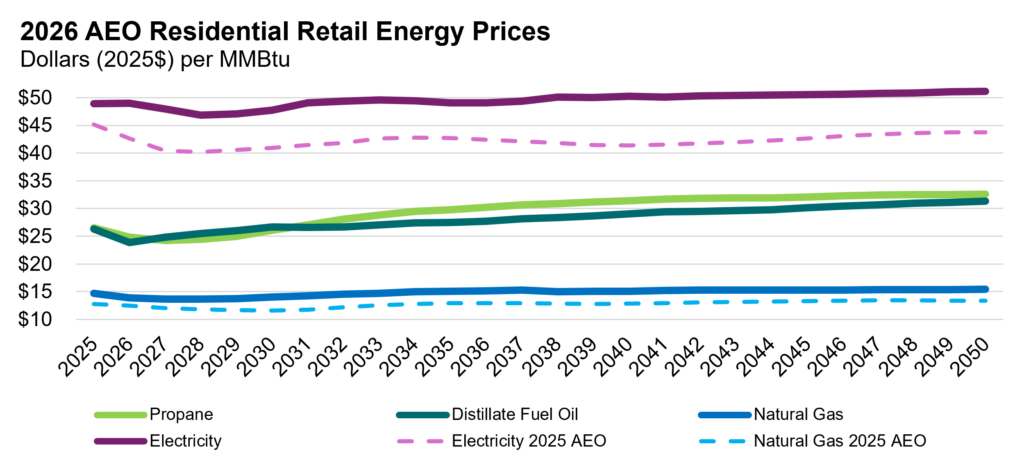
The Energy Information Administration (DOE) newly updated Annual Energy Outlook (AEO) projects that electricity will remain more expensive than competing fuels, such as natural gas, over the long term, with the 2026 outlook showing a wider cost gap than the projections released last year. Most of the increase is due to expectations for higher costs for electric generation and utility distribution. For residential customers, the impact of higher distribution costs may change over time if costs can be spread out across more average daily use. If peak demand remains high and off-peak use falls, fixed system costs will be spread across fewer kilowatt-hours, raising average prices. Overall, the 2026 AEO projects that the national average residential retail cost of electricity relative to natural gas will stay within a range of around 3.3–3.5 times higher through 2050.
Key Findings
- Natural gas and electricity prices are both projected to rise modestly (~5%) through 2050 in the 2026 AEO. Propane and fuel oil forecasts changed little from the 2025 outlook, with long-term prices still rising by about 20–23%.
- While the projected paths for natural gas and electricity prices are similar across the 2025 and 2026 AEOs, higher electricity prices will have a larger impact on consumer affordability because all U.S. households use electricity. As a result, the average household spends X% more on electricity than natural gas, even for similar services.
- Electricity costs are expected to rise across the board over the projection period, driven by distribution and generation costs. By 2050, generation could account for 46% of electricity costs, followed by distribution at 35% and transmission at 19%. All three cost components rise on a per-kWh basis, with the largest increases coming from distribution and generation.
- While the 2026 AEO shows little change in peak uses such as space heating and cooling, it projects lower off-peak electricity use, including EV charging, which can raise average prices by spreading fixed costs over fewer kilowatt-hours.
EIA Annual Energy Outlook Regional Projections
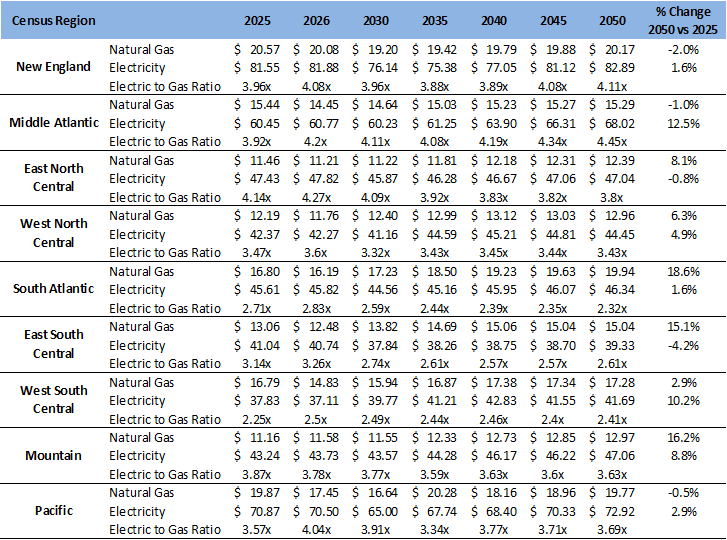
Source: Energy Information Administration // AGA Contact: Brendan O’Brien (bobrien@aga.org) 202-824-7220.
In issuing and making this publication available, AGA is not undertaking to render professional or other services for or on behalf of any person or entity. Nor is AGA undertaking to perform any duty owed by any person or entity to someone else. Anyone using this document should rely on his or her own independent judgment or, as appropriate, seek the advice of a competent professional in determining the exercise of reasonable care in any given circumstances. The statements in this publication are for general information and represent an unaudited compilation of statistical information that could contain coding or processing errors. AGA makes no warranties, express or implied, nor representations about the accuracy of the information in the publication or its appropriateness for any given purpose or situation. This publication shall not be construed as including advice, guidance, or recommendations to take, or not to take, regarding any matter, including without limitation relating to investments or the purchase or sale of any securities, shares or other assets of any kind. Should you take any such action or decision; you do so at your own risk. Information on the topics covered by this publication may be available from other sources, which the user may wish to consult for additional views or information not covered by this publication.
Copyright © 2026 American Gas Association. All rights reserved