Heating Trends in New Single-Family Homes
Source: US Census Bureau: Characteristics of New Housing 2024
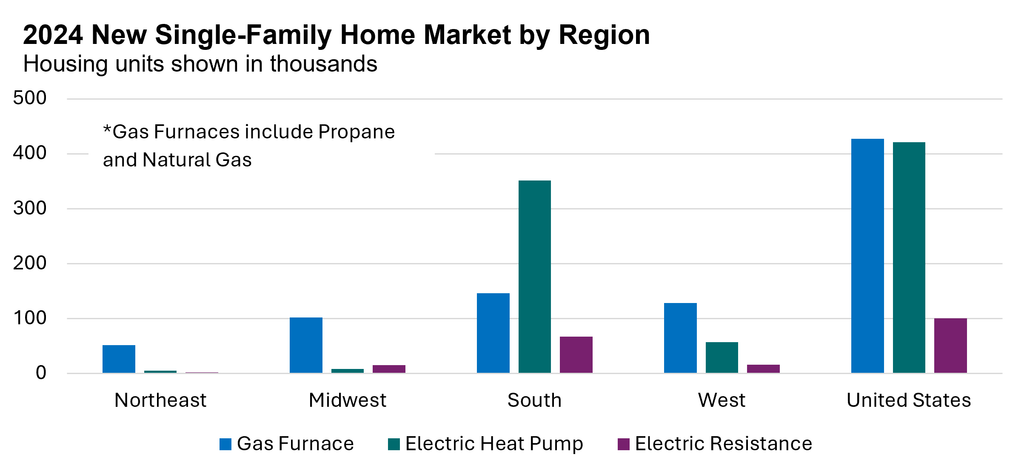
Analysis of Census Bureau data on new housing characteristics indicates that natural gas remains a significant heating option in new single-family home construction, despite changes in market share over the past decade. While electric heat pumps have experienced substantial growth, gas adoption (including natural gas and propane) remains elevated relative to historical levels, supported by continued growth in overall housing construction and strong regional demand. Census division-level analysis reveals substantial differences in heating preferences nationwide, underscoring the ongoing significance of infrastructure availability, climate conditions, and regional building practices in influencing heating technology decisions.
Key Findings
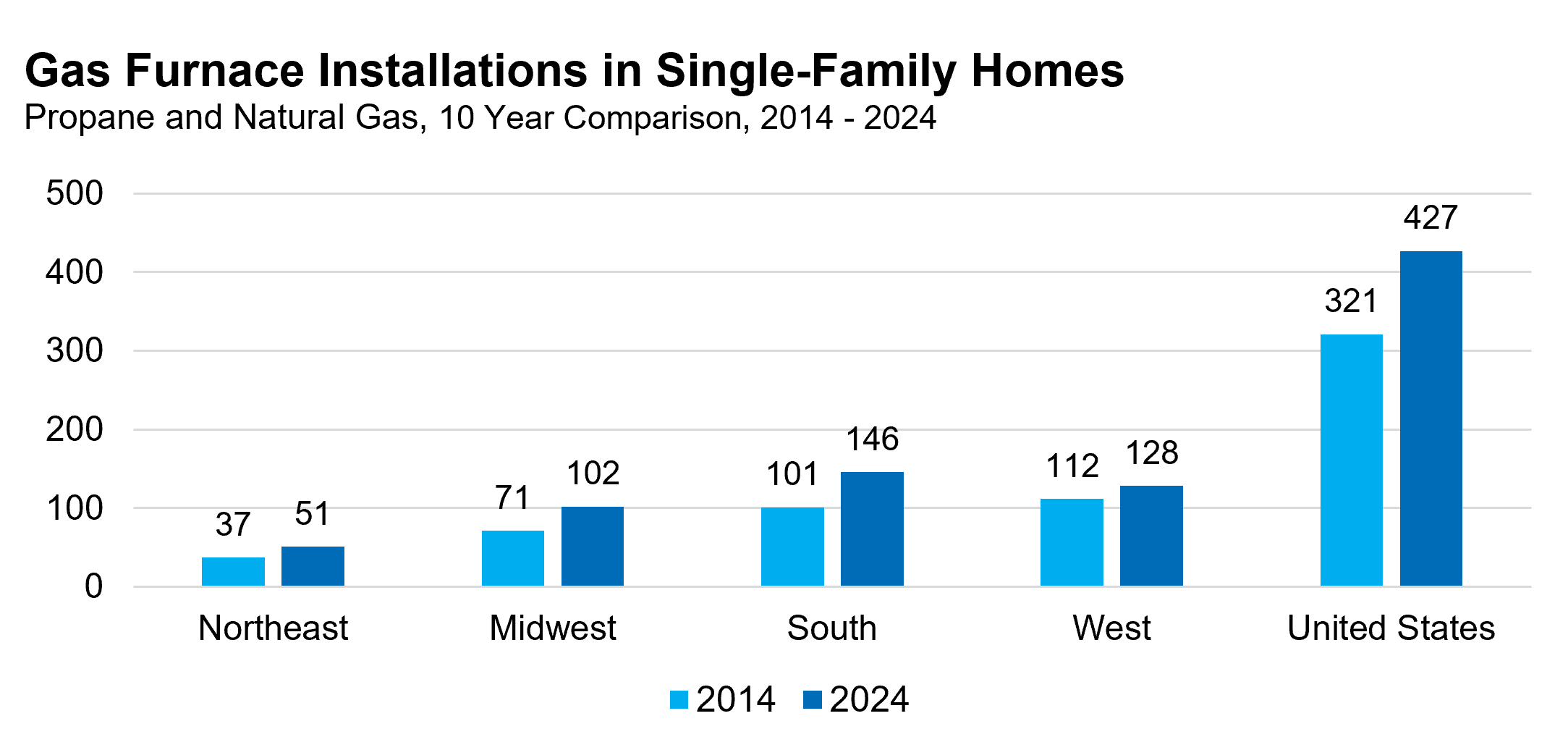
- Natural gas and propane furnace market share declined from 53.8 percent in 2014 to 43.0 percent in 2024. Despite this decline, the annual installation of natural gas and propane furnaces increased from approximately 321,000 homes to 427,000 homes. The increase in total installations suggests that a declining market share does not necessarily indicate a decline in demand or new consumers.
- Regional heating markets remain highly differentiated, with natural gas maintaining a strong position in the Midwest and Northeast and electric heat pumps exhibiting the greatest penetration in the South.
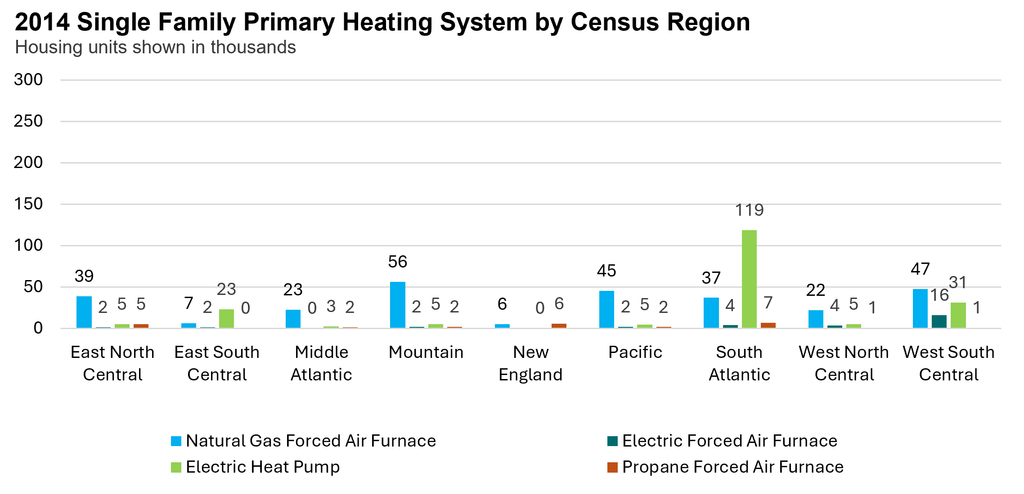
- Electric heat pump and natural gas/ propane furnace installations increased across nearly every Census division since 2014, indicating that growth in heat pump adoption has often occurred alongside continued growth in natural gas and propane heating.
- Initial findings suggest that growth in overall housing construction has supported market expansion of both technologies, meaning natural gas adoption increased even with shifts in market share.
Source: US Census Bureau: Characteristics of New Housing 2014, 2024
Regional Heating Markets Remain Distinct
Gas furnace market share declined from 53.8 percent in 2014 to 43.0 percent in 2024. This trend was primarily driven by significant demand for new homes in the South. In other parts of the US, gas furnaces had a market share of 86% in 2014 and 73% in 2024, exceeding electric by four-to-one in 2024.
- Regional differences in heating system adoption remain pronounced. In 2024, the Midwest and Northeast continued to exhibit the highest levels of gas furnace adoption, while electric heat pump installations were concentrated primarily in the South.
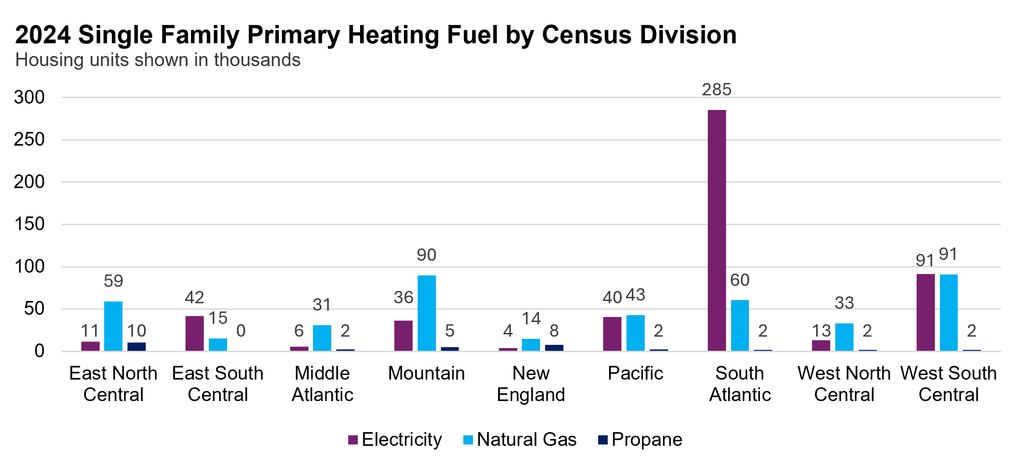
- Growth in electric-heated homes in the South could have more to do with preferences around cooling needs than efficient space heating. Nearly 60 percent of all heat pumps were installed in the South Atlantic region alone.
- Heat pump growth may also be driven by overall demand for housing outpacing the ability to build any one type of home. The South Atlantic region also contributed 35 percent of all new single-family homes built in 2024. The West South Central region contributed the second largest share of new homes in 2024 but only added 19 percent of all homes.
- The Midwest remains the most gas-intensive region, with gas accounting for over 80 percent of all heating system installations in single-family homes.
- The Northeast continues to rely heavily on gas heating in new construction.
- Electric heat pump adoption is concentrated in the South, where installations exceeded gas furnace installations by more than two-to-one in 2024.
- The West exhibits a more balanced mix of heating technologies.
- Electric resistance heating in 2024 represents a small, 18 percent share of electric-heated new construction across all regions.
Census Division Heating Installations in New Construction
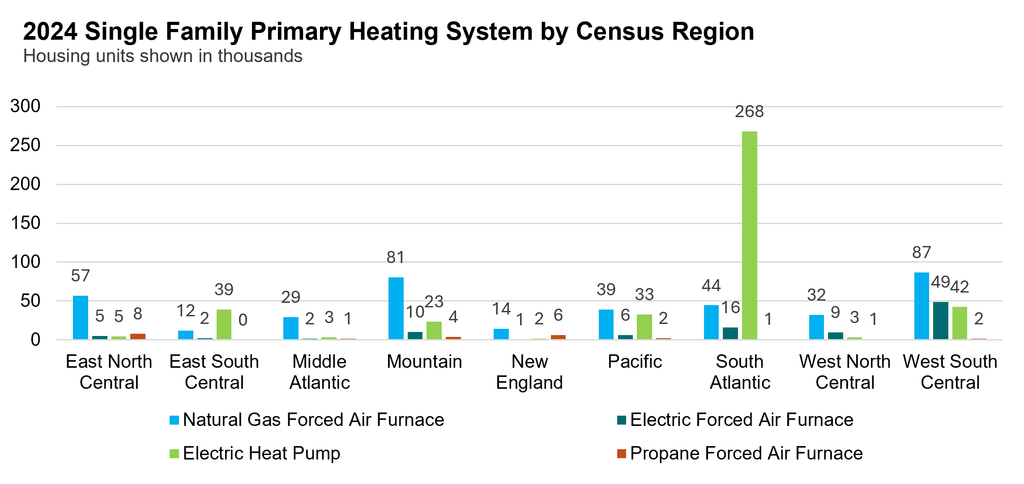
- East North Central, Mountain, and West South Central: These areas remain among the strongest furnace-oriented markets in the country. Natural gas furnace installations continue to significantly outpace heat pump adoption.
- West North Central and Middle Atlantic – Both divisions maintain a strong preference for natural gas furnace systems, with installations substantially exceeding heat pump adoption.
- Pacific – Natural gas furnaces and heat pumps account for similar levels of adoption, suggesting that both technologies continue to play meaningful roles in new residential construction.
- East South Central – Heat pump adoption exceeds natural gas furnace installations, with heat pumps accounting for roughly three times as many installations in 2024.
- South Atlantic – The nation’s largest heat pump market and the division most heavily oriented toward heat pump adoption. In 2024, heat pump installations in the region surpassed natural gas furnace installations by nearly 5-to-1, making the South Atlantic the primary driver of national heat pump growth.
Source: US Census Bureau: Characteristics of New Housing 2024
Heat Pump Growth and Natural Gas Adoption Are Not Mutually Exclusive
Source: US Census Bureau: Characteristics of New Housing 2014
Source: US Census Bureau: Characteristics of New Housing 2024
Source: Energy Information Administration // AGA Contact: Brendan O’Brien (bobrien@aga.org) 202-824-7220.
In issuing and making this publication available, AGA is not undertaking to render professional or other services for or on behalf of any person or entity. Nor is AGA undertaking to perform any duty owed by any person or entity to someone else. Anyone using this document should rely on his or her own independent judgment or, as appropriate, seek the advice of a competent professional in determining the exercise of reasonable care in any given circumstances. The statements in this publication are for general information and represent an unaudited compilation of statistical information that could contain coding or processing errors. AGA makes no warranties, express or implied, nor representations about the accuracy of the information in the publication or its appropriateness for any given purpose or situation. This publication shall not be construed as including advice, guidance, or recommendations to take, or not to take, regarding any matter, including without limitation relating to investments or the purchase or sale of any securities, shares or other assets of any kind. Should you take any such action or decision; you do so at your own risk. Information on the topics covered by this publication may be available from other sources, which the user may wish to consult for additional views or information not covered by this publication.
Copyright © 2026 American Gas Association. All rights reserved